


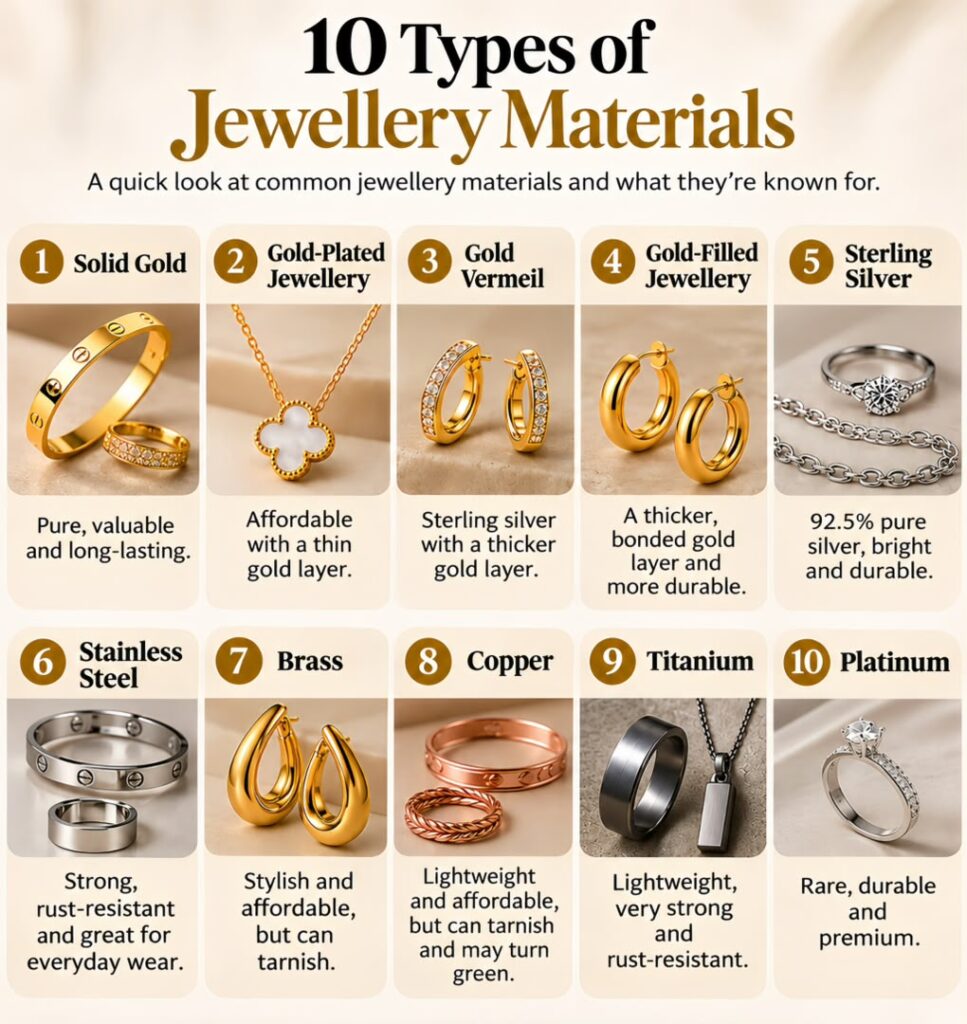
Jewellery is more than design and appearance. The material used to make a piece affects its quality, durability, selling price, maintenance requirements and the kind of customer it is suitable for.
Jewellery is more than design and appearance. The material used to make a piece affects its quality, durability, selling price, maintenance requirements and the kind of customer it is suitable for.
As a jewellery entrepreneur, understanding jewellery materials is essential. Two pieces may look almost identical but differ significantly in composition, value and performance. A gold-coloured necklace, for example, may be made from real gold, gold-plated metal, gold-filled material or brass with a gold-coloured finish.
Knowing these differences helps you make better purchasing decisions, price your products appropriately and give customers accurate information.
Let’s explore 10 common jewellery materials and what you should know about each one.
1. Real Gold
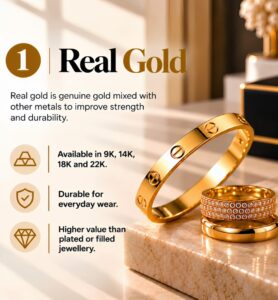
Gold is a precious metal valued for its beauty, rarity and lasting appeal. It is used to make rings, necklaces, bracelets, earrings and other jewellery pieces.
Pure gold is known as 24-karat gold. Because it is relatively soft, it is often mixed with other metals to improve its strength and suitability for everyday jewellery.
Gold purity is measured in karats:
- 24K gold: Approximately 99.9% gold.
- 18K gold: 75% gold.
- 14K gold: Approximately 58.3% gold.
- 9K gold: 37.5% gold.
The remaining percentage consists of other metals. These can influence the gold’s colour, hardness and other properties.
Gold jewellery may be yellow, white or rose gold, depending on its alloy composition and, in some cases, its surface finish.
Advantages
- Precious metal with intrinsic material value.
- Does not rust and is generally resistant to tarnishing.
- Available in different purities and colours.
Limitations
- Usually more expensive than base-metal alternatives.
- Higher-purity gold is softer and can scratch or deform more easily.
- White gold may require occasional replating to maintain its appearance, depending on its finish.
2. Gold-Plated Jewellery
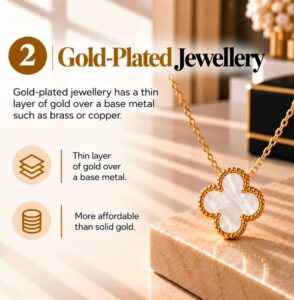
Gold-plated jewellery is made by applying a layer of gold over another metal. The underlying material may be brass, copper, stainless steel or another suitable base metal.
This process gives the jewellery a gold-like appearance without requiring the entire piece to be made from gold. It is therefore a popular option for affordable fashion jewellery.
However, the thickness and quality of the gold layer can vary considerably. With wear, the coating may gradually fade, scratch or wear away, particularly when exposed to friction, sweat, moisture, perfumes and cleaning products.
Advantages
- More affordable than jewellery made entirely from gold.
- Offers the appearance of gold at a lower price.
- Available in many styles and designs.
Limitations
- The gold coating can wear away over time.
- Durability depends on the coating, base metal and care.
- The underlying metal may become visible as the coating wears.
3. Gold Vermeil
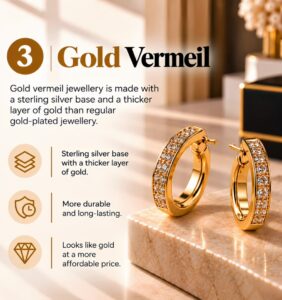
Gold vermeil is a particular type of gold-plated jewellery. It uses sterling silver as its base metal, with a layer of gold applied to the surface.
This distinguishes it from ordinary gold-plated jewellery, which can use various base metals. Vermeil is often positioned as a premium alternative for customers who want the appearance of gold with a sterling silver base.
The term has specific requirements in some markets. For example, the United States Federal Trade Commission’s guidance defines vermeil using sterling silver and a gold coating of at least 10 karats and approximately 2.5 microns in thickness. Requirements may differ across jurisdictions. Source: FTC Jewelry Guides
Advantages
- Has a sterling silver base.
- Offers a gold finish with a more valuable underlying metal than many basic plated pieces.
- Suitable for customers seeking an alternative to solid gold.
Limitations
- The gold layer can still wear away.
- It usually costs more than basic gold-plated jewellery.
- It requires appropriate care to preserve its finish.
4. Gold-Filled Jewellery
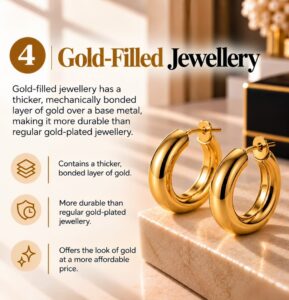
Gold-filled jewellery has a layer of gold mechanically bonded to a base metal. Unlike ordinary gold plating, which generally uses a thinner surface coating, gold-filled construction contains a more substantial layer of gold.
When properly manufactured, gold-filled jewellery can be more resistant to everyday wear than standard gold-plated jewellery. However, its lifespan still depends on the quality of construction, how frequently it is worn and how it is maintained.
Gold-filled jewellery is not the same as solid gold. The gold is concentrated in an outer layer rather than making up the entire piece.
Advantages
- Generally more durable than standard gold plating.
- Provides a gold surface without the cost of solid gold.
- Can be suitable for frequent wear when well made and maintained.
Limitations
- Not equivalent to solid gold.
- The outer layer can eventually wear or become damaged.
- Quality and terminology should be verified with the supplier.
5. Sterling Silver
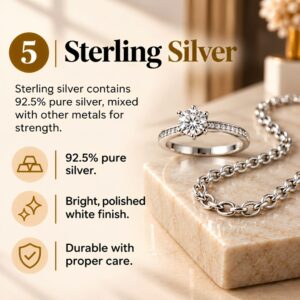
Sterling silver is a precious-metal alloy containing 92.5% silver, with the remaining portion usually made up of other metals to improve strength. It is commonly marked 925, referring to 925 parts silver per 1,000 parts of the alloy.
Sterling silver is widely used in rings, chains, earrings, bracelets and pendants. Its bright, neutral colour makes it suitable for both simple everyday pieces and detailed designs.
One of its common characteristics is tarnishing. Silver can react with substances in its environment and gradually develop a darker surface. This is generally a surface change that can often be corrected through suitable cleaning and polishing.
Advantages
- Contains a high proportion of precious silver.
- Offers a classic appearance and versatility.
- Can often be cleaned and polished to restore its shine.
Limitations
- Can tarnish over time.
- May scratch, bend or become damaged depending on the design and use.
- Requires appropriate storage and maintenance.
6. Stainless Steel
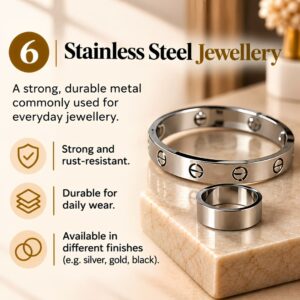
Stainless steel is a metal alloy used in many types of fashion and everyday jewellery. It is valued for its strength and resistance to corrosion, making it a practical choice for pieces intended for regular use.
Some jewellery is made from particular grades of stainless steel, such as 316L. However, the exact grade and composition should be confirmed rather than assumed.
Stainless steel can also be finished in different colours. Gold-coloured stainless steel, for example, may have a surface coating or treatment, and the finish may wear differently from the underlying steel.
Advantages
- Strong and generally corrosion-resistant.
- Often affordable and suitable for everyday designs.
- Available in a wide variety of styles.
Limitations
- Can scratch despite its strength.
- Coloured coatings may wear over time.
- Some people may react to certain alloy components, depending on the composition and their sensitivities.
7. Brass
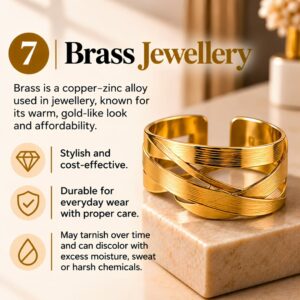
Brass is an alloy made primarily from copper and zinc. It is popular in fashion jewellery because it is versatile, relatively affordable and suitable for creating a wide range of shapes and designs.
Brass may be used in its natural golden colour or covered with a finish to create another appearance. It is often found in statement earrings, bangles, pendants, decorative rings and other fashion accessories.
Although brass can be durable when properly made and cared for, it can tarnish or change colour with exposure to moisture, sweat, air and certain chemicals.
Advantages
- Generally affordable and versatile.
- Suitable for bold, detailed and decorative designs.
- Can be polished or finished in different ways.
Limitations
- May tarnish or discolour.
- Some pieces may leave greenish marks on the skin.
- Its suitability for sensitive skin depends on its composition and any coating.
8. Copper
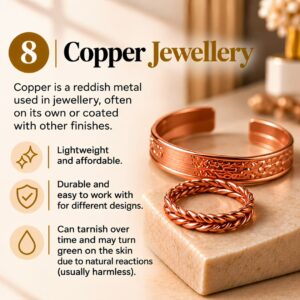
Copper is a reddish-brown metal that can be used on its own or combined with other metals to create alloys. It appears in jewellery ranging from handmade pieces to contemporary and artistic designs.
Copper develops a patina as it reacts with its surroundings. Depending on the conditions, this can darken its appearance or create greenish surface changes. Contact with sweat and moisture can also sometimes leave greenish marks on the skin.
Advantages
- Has a distinctive natural colour.
- Can be shaped into different designs.
- Often used in handmade, artistic and statement jewellery.
Limitations
- Can tarnish and change colour.
- Requires maintenance to preserve a polished appearance.
- May leave marks on the skin, and individual reactions can vary.
9. Titanium
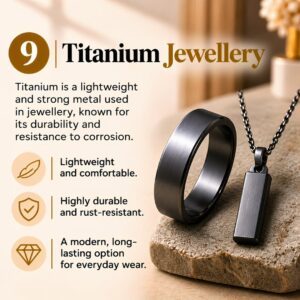
Titanium is a strong, lightweight metal known for its resistance to corrosion. It is used in certain rings, earrings and contemporary jewellery designs.
Its combination of low weight and strength makes it useful for customers who prefer jewellery that feels lighter on the body. Titanium is also used in some jewellery designed for people who need to be particularly mindful of metal sensitivities, although the exact composition and finish still matter.
Advantages
- Lightweight yet strong.
- Highly resistant to corrosion.
- Useful for modern, practical jewellery designs.
Limitations
- Some designs can be difficult to resize or repair.
- It may be less familiar to customers who usually buy gold or silver.
- Quality and suitability depend on the specific grade and construction.
10. Platinum
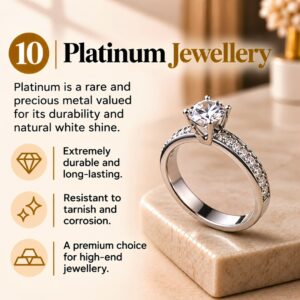
Platinum is a rare, naturally white precious metal used in fine jewellery, including engagement rings, wedding bands and other high-value pieces.
It is valued for its density, durability and resistance to corrosion. Platinum jewellery is usually made from an alloy rather than completely pure platinum, so the percentage of platinum in the piece is important.
Although platinum is durable, it is not scratch-proof. Its surface can develop marks through regular wear, and its appearance may change over time.
Advantages
- A precious metal with a naturally white appearance.
- Durable and resistant to corrosion.
- Widely used in fine jewellery and wedding jewellery.
Limitations
- Usually more expensive than many alternative materials.
- Its density can make it feel heavier than other metals.
- Can scratch and may require professional maintenance.
How to Choose the Right Jewellery Materials for Your Business
Understanding the materials is only the first step. The next is deciding which ones suit your target customers, product range and business model.
1. Understand your target market
Different customers have different priorities. Some are looking for affordable fashion pieces, while others prefer precious metals for their value, longevity or significance.
Your product selection should reflect what your customers want and what they can comfortably afford.
2. Consider durability and maintenance
Think about how customers will use the jewellery. Everyday pieces may need different material properties from occasional statement accessories.
Also consider how easy the pieces are to clean, maintain or repair.
3. Understand the actual cost
The cost of a jewellery piece is not determined by its material alone. You may also need to account for design, workmanship, packaging, shipping, customs charges, local delivery and other business expenses.
These costs should be considered when calculating your final cost price and setting a selling price.
4. Verify your suppliers
A supplier’s product description is not always enough to establish the true composition of a piece. Ask questions, request available specifications and seek independent testing when the value or risk justifies it.
Be especially careful with claims such as “real gold,” “925 silver,” “gold-filled” and “hypoallergenic.”
5. Educate your customers honestly
Your product descriptions should explain what each item is made from, whether it has a coating, how to care for it and any relevant limitations.
Accurate information builds trust and helps customers make informed decisions.
Common Mistakes Jewellery Entrepreneurs Should Avoid
- Buying based on appearance alone: Two pieces can look alike but have very different materials and values.
- Assuming gold-coloured means gold: A gold-coloured finish does not prove that a piece contains gold.
- Confusing plated with filled: Gold plating and gold-filled construction are different.
- Making unsupported claims: Avoid promising that a piece will never tarnish, never fade or never cause a skin reaction unless the claim can be substantiated.
- Ignoring care instructions: Even durable materials can be damaged by unsuitable handling or maintenance.
- Pricing without understanding the material: Your pricing decisions should be informed by composition, quality, workmanship and all relevant costs.
Final Thoughts
There is no single jewellery material that is best for every product or customer. Real gold, sterling silver and platinum serve different needs from gold-plated jewellery, brass, copper, stainless steel and titanium.
The goal is to understand what each material offers, where its limitations lie and which customers it is best suited for.
As a jewellery entrepreneur, your knowledge of the products you sell is part of the value you offer. When you understand your materials, you can source more confidently, price more accurately, communicate more honestly and build stronger relationships with your customers.
Let’s discuss: Which of these 10 jewellery materials do you sell most often, and what has your experience been with its quality and durability?